What Is SEO? A Complete Guide to Search Engine Optimization
If you’ve ever typed a question into Google and clicked one of the first results, you’ve experienced SEO in action.
Search Engine Optimization (SEO) is the practice of improving a website so it shows up higher in unpaid (“organic”) search results when people search for topics related to that site. It’s not about tricking a search engine — it’s about making a page genuinely easier to find, understand, and trust, for both algorithms and human readers.
Search engines exist to do one job: organize the world’s information and serve the most helpful, relevant answer to whatever someone types into the search bar. SEO is how you help your content qualify as that answer — whether the searcher is in Delhi, Lagos, São Paulo, or Toronto.
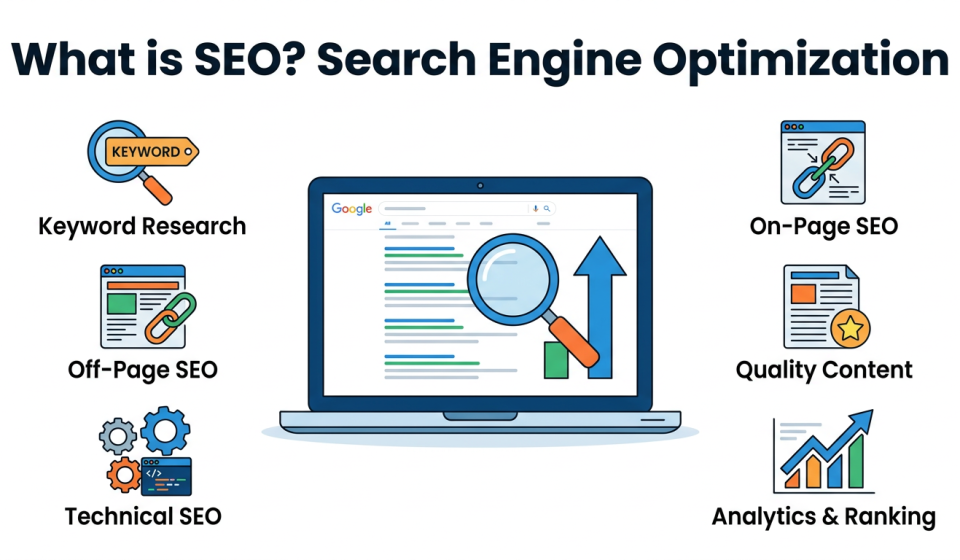
SEO typically blends three areas of work:
- Content optimization — making sure your pages answer real questions clearly
- Technical optimization — making sure your site loads fast and is easy to crawl
- Authority building — earning trust signals like backlinks and brand mentions
None of this is location-specific. The same core principles apply whether you’re optimizing a site for a local bakery or a global SaaS company.
Why SEO Matters — Wherever You Are in the World
Search is still one of the biggest entry points to the internet, no matter which country or language you’re working in. A few reasons SEO remains essential:
- It’s free traffic. Once a page ranks well, it can keep attracting visitors for months or years without ongoing ad spend.
- It builds trust. People instinctively view top-ranking pages as more credible and authoritative.
- It reaches people at the exact moment of intent. Someone searching “best running shoes for flat feet” is actively looking for a solution — that’s a much warmer audience than someone scrolling social media.
- It levels the playing field. A well-optimized small business page can outrank a much bigger competitor if it better matches what searchers actually want.
- It works everywhere. SEO principles apply across regions and languages — only the specific keywords, competitors, and cultural context change.
The top few organic results on any search engine capture the large majority of clicks, while pages further down the results page see very little traffic — which is exactly why ranking position matters so much.
How Search Engines Actually Work
To understand SEO, it helps to understand what search engines are doing behind the scenes. There are three main steps:
1. Crawling
Search engines send automated programs (often called “bots” or “spiders”) across the web to discover new and updated pages. Think of this like a librarian walking through the stacks, noting every new book that arrives.
2. Indexing
Once a page is crawled, the search engine analyzes its content and stores it in a massive database called an index — essentially the search engine’s “library.” A page can’t rank if it isn’t indexed.
3. Ranking
When someone searches a query, the search engine scans its index and ranks the most relevant, high-quality, trustworthy pages at the top. Ranking algorithms weigh hundreds of factors, including content relevance, site speed, mobile-friendliness, backlinks, and overall user experience.
SEO is essentially the practice of making all three of these steps work in your favor.
The Three Types of SEO
Most SEO work falls into one of three categories.
On-Page SEO
This covers everything on your actual page: title tags, headings, keyword usage, content quality, internal links, and image alt text. It’s the part of SEO you have the most direct control over.
Key on-page elements:
- Title tags (ideally 50–60 characters, primary keyword near the front)
- Meta descriptions (under ~160 characters)
- Clear H1 → H2 → H3 heading structure
- Content that genuinely answers the search intent behind a query
- Internal links connecting related pages on your site
Technical SEO
This is the “engine room” of your website — making sure search engines can crawl and understand your site efficiently.
Key technical factors:
- Fast page load speed
- Mobile responsiveness
- Secure HTTPS connection
- Clean site structure and XML sitemaps
- No broken links or crawl errors
Off-Page SEO
This covers everything that happens outside your website that still affects how it’s perceived — mainly backlinks (other sites linking to yours) and brand mentions. Off-page SEO is harder to control directly because it depends on other people and sites choosing to reference you, but it can be earned through outreach, partnerships, and genuinely link-worthy content.
| SEO Type | What It Controls | Example Actions |
|---|---|---|
| On-Page | Content & HTML elements | Keyword research, headings, meta tags |
| Technical | Site infrastructure | Site speed, mobile optimization, HTTPS |
| Off-Page | External reputation | Backlinks, PR, brand mentions |
SEO vs. SEM: What’s the Difference?
People often confuse SEO with SEM (Search Engine Marketing), but they’re not the same thing.
- SEO focuses purely on earning organic (unpaid) rankings through optimization.
- SEM is the broader umbrella that includes SEO and paid search advertising, like Google Ads pay-per-click campaigns.
In everyday conversation, “SEM” is often used loosely to mean paid search specifically, while “SEO” refers strictly to unpaid, organic visibility. The main practical difference: with SEO you don’t pay per click, but results take longer to build; with SEM (paid ads) you can get visibility almost immediately, but traffic stops the moment you stop paying.
How SEO Is Changing in the Age of AI
SEO in 2026 looks different from SEO a few years ago. Search engines increasingly generate AI-powered summaries directly on the results page, answering many queries without requiring a click at all. This has pushed SEO to expand beyond traditional rankings into what’s sometimes called Generative Engine Optimization (GEO) — optimizing content so AI systems can understand, summarize, and cite it accurately.
What this means in practice:
- Clear, direct answers matter more. Content that answers a question in the first few sentences is more likely to be pulled into an AI summary.
- Structured formatting helps. Headings, bullet points, tables, and FAQs make it easier for both humans and AI systems to parse your content.
- E-E-A-T still matters. Google’s quality framework — Experience, Expertise, Authoritativeness, Trustworthiness — remains central to how both classic rankings and AI-generated answers are formed.
- Brand recognition helps AI trust you. When people search your brand name directly, or your site is cited elsewhere, it signals to AI systems that you’re a credible source.
The core principle hasn’t changed: create the most genuinely useful answer to a real question, and structure it so it’s easy to find and understand — whether by a person, a search bot, or an AI model.
How to Get Started With SEO: A Simple Checklist
If you’re brand new to SEO, here’s a practical starting sequence:
- Fix the technical basics — confirm your site loads quickly, works on mobile, and uses HTTPS.
- Pick a primary keyword per page — one clear topic that matches real search intent.
- Write genuinely helpful content — answer the question completely; don’t pad for length.
- Structure with headings — use a logical H1 → H2 → H3 hierarchy.
- Add internal links — connect related pages on your own site.
- Earn backlinks over time — through useful content, outreach, and partnerships, never purchased links.
- Track your performance — set up free tools like Google Search Console and Google Analytics to monitor what’s working.
- Be patient and consistent — SEO is a long-term strategy; meaningful results typically take a few months to build.
Common SEO Mistakes to Avoid
- Keyword stuffing — cramming keywords unnaturally instead of writing for humans first
- Ignoring mobile users — most searches now happen on mobile devices
- Buying backlinks or email lists — this violates search engine guidelines and can get a site penalized
- Publishing thin content — pages that don’t fully answer the question rarely rank well
- Neglecting page speed — slow-loading pages lose both rankings and visitors
- Treating SEO as a one-time task — algorithms and competitors change, so SEO requires ongoing attention
Frequently Asked Questions
What does SEO stand for?
SEO stands for Search Engine Optimization — the practice of improving a website to increase its visibility in unpaid search results.
Is SEO free?
SEO itself doesn’t require ad spend, but it does require time, effort, and often investment in content creation, tools, or expertise. It’s “free” in the sense that you don’t pay per click or per visitor.
How long does SEO take to work?
Most websites start seeing meaningful movement within three to six months, with stronger results building over a year or more. SEO is a long-term, compounding strategy rather than an instant fix.
Does SEO work the same way in every country?
The core mechanics — crawling, indexing, ranking, and matching search intent — are consistent across regions. What changes is the language, competitors, cultural context, and sometimes the dominant search engine (for example, Baidu in China or Yandex in parts of Russia).
Can I do SEO myself, or do I need an agency?
Many fundamentals — like clear content, good headings, and mobile-friendliness — are things a beginner can learn and apply directly. Larger or more competitive projects often benefit from specialized help, but starting with the basics yourself is entirely realistic.
What is the difference between organic and paid search results?
Organic results are unpaid listings ranked by relevance and quality, while paid results are advertisements you pay for on a per-click or per-impression basis, usually labeled “Sponsored” or “Ad.”
Conclusion
At its core, SEO is simple: give search engines — and the people using them — the most genuinely useful, well-structured, and trustworthy answer to their question. Everything else, from technical fixes to backlink building to AI-era formatting, exists to support that one goal.
Whether you’re a solo blogger, a local shop owner, or part of a global brand, the fundamentals of SEO apply the same way: understand what people are actually searching for, build content and a site that serves that intent well, and stay patient as your visibility compounds over time.
Next step: Start small. Pick one page on your site, review its title, headings, and content against real search intent, and improve it using the checklist above.